
Publications

This page features all publications developed and published as part of 6G-NTN, including journal, conference and white papers. You can explore (and download) the publications directly on this page or visit the 6G-NTN community on Zenodo.

Note: The 6G-NTN publications uploaded to the project community on Zenodo will be retained for the life of Zenodo, which is expected to continue for at least the next 20 years (as long as its host, CERN, continues its experimental programmes). ​


NEW Scientific publication
White paper

Vision on Non-Terrestrial Networks in 6G system (or IMT-2030)

Use Cases, Requirements, and Possible Standardisation approach: A Perspective from the 6G-NTN Project

Thales Alenia Space France, Ericsson Sweden and Ericsson France, Qualcomm France, SES Techcom, Thales – SIX, Telit Cinterion, GreenerWave, Martel Innovate, Digital for Planet, CTTC, German Aerospace Center – DLR, Alma Mater Studiorum – University of Bologna
In this white paper, the 6G-NTN consortium partners provide a consolidated view on NTN in 6G.

The paper includes an identification of the targeted market segments, connectivity scenarios, general design principles for NTN in 6G followed by a proposed standardization approach.

Scientific Publication

Federated Cell-Free MIMO in Non-Terrestrial Networks: Architectures and Performance

Alessandro Guidotti, Alessandro Vanelli-Coralli, Carla Amatetti
While 5G networks are being rolled out, the definition of the potential 5G-Advanced features and the identification of disruptive technologies for 6G systems are being addressed by the scientific and academic communities to tackle the challenges that 2030 communication systems will face, such as terabit-capacity and always-on networks. In this framework, it is globally recognised that Non-Terrestrial Networks (NTN) will play a fundamental role in support to a fully connected world, in which physical, human, and digital domains will converge. In this framework, one of the main challenges that NTN have to address is the provision of the high throughput requested by the new ecosystem. In this paper, we focus on Cell-Free Multiple Input Multiple Output (CF-MIMO) algorithms for NTN. In particular: i) we discuss the architecture design supporting centralised and federated CF-MIMO in NTN, with the latter implementing distributed MIMO algorithms from multiple satellites in the same formation (swarm); ii) propose a novel location-based CF-MIMO algorithm, which does not require Channel State Information (CSI) at the transmitter; and iii) design novel normalisation approaches for federated CF-MIMO in NTN, to cope with the constraints on non-colocated radiating elements. The numerical results substantiate the good performance of the proposed algorithm, also in the presence of non-ideal information.

DOI: 10.48550/arXiv.2302.00057

Conference Paper

Assessment of Beamforming Algorithms with Subarrayed Planar Arrays for B5G/6G LEO Non-Terrestrial Networks

M. Rabih Dakkak, Daniel Gaetano Riviello, Alessandro Guidotti, Alessandro Vanelli-Coralli at European Wireless 2023 – 6G Driving a Sustainable Growth – ITA NTN: Workshop on Integrated Terrestrial and Non-Terrestrial-Networks, October 2023
Non-Terrestrial Networks (NTNs) in Beyond 5G (B5G) and 6G ecosystems are expected to play a crucial role in providing the requests of connections anywhere and anytime by offering wide-area coverage and ensuring service availability, continuity, and scalability. Full Frequency Reuse (FFR) schemes, which are able in cooperation with digital beamforming algorithms to cope with the substantial co-channel interference, are considered to be an efficient solution to meet the growing demand of high data rates in B5G/6G systems. In this paper, we propose a Limited Field Of View (LFOV) planar array architecture composed of smaller planar subarrays in order to increase the directivity of an on-board Low Earth Orbit (LEO) satellite antenna array and mitigate the interference. We evaluate the performance of feed-space beamforming schemes, including both full digital schemes based on Channel State Information (CSI) at the transmitter, such as Minimum Mean Square Error (MMSE), and full analog schemes that only require the users’ locations, such as Conventional Beamforming (CBF). The numerical results of the system performance, presented by means of spectral efficiency, demonstrate a remarkable improvement in the proposed beamforming design with subarraying w.r.t. the one with no subarrayed configuration; in particular, we show that an analog beamforming scheme with subarraying can outperform a full digital beamforming scheme with no subarraying.

Scientific publication

Open Datasets for AI-Enabled Radio Resource Control in Non-Terrestrial Networks

Husnain Shahid, Miguel Angel V´azquez ´, Laurent Reynaud , Fanny Parzysz, Musbah Shaat at “Symposium on Non-terrestrial Communications in Future Networks” at IEEE Future Network World Forum 2023​ – November 13, 2023 – Baltimore, USA

By effectively implementing the strategies for resource allocation, the capabilities, and reliability of non-terrestrial networks (NTN) can be enhanced. This leads to enhance spectrum utilization performance while minimizing the unmet system capacity, meeting quality of service (QoS) requirements and overall system optimization. In turn, a wide range of applications and services in various domains can be supported. However, allocating resources in a multi-constellation system with heterogeneous satellite links and highly dynamic user traffic demand pose challenges in ensuring sufficient and fair resource distribution. To mitigate these complexities and minimize the overhead, there is a growing shift towards utilizing artificial intelligence (AI) for its ability to handle such problems effectively. This calls for the development of an intelligent decision-making controller using AI to efficiently manage resources in this complex environment. In this context, real-world open datasets play a pivotal role in the development of AI models addressing radio control optimization problems. As a matter of fact, acquiring suitable datasets can be arduous. Therefore, this paper identifies pertinent real-world open datasets representing realistic traffic pattern, network performances and demand for fixed and dynamic user terminals, enabling a variety of uses cases. The aim of gathering and publishing the information of these datasets are to inspire and assist the research community in crafting the advance resource management solutions. In a nutshell, this paper establishes a solid foundation of commercially accessible data, with the potential to set benchmarks and accelerate the resolution of resource allocation optimization challenges.

DOI: 10.48550/arXiv.2404.12813

Conference Proceeding

Analysis of Graph-Based User Scheduling for KA-Band LEO NTN Systems

Bilal Ahmad , Daniel Gaetano Riviello, Bruno De Filippo, Alessandro Guidotti , Alessandro Vanelli-Coralli
This work focuses on the next generations of multi-beam (MB) Low Earth Orbit (LEO) based NonTerrestrial Network (NTN) architectures that exploit full spectrum reuse schemes and effective interference management techniques by employing user scheduling before precoding at the transmit side. Given a high density of user terminals (UTs) on-ground as compared to on-board LEO satellite antennas it is extremely challenging to schedule users. To improve the performance, optimal user scheduling is necessary. In this paper, we present the analysis of graph-based user scheduling algorithms for Ka-band, with a focus on feed space (FS), downlink (DL), and Frequency Division Duplex (FDD) mode. We propose both a distance-based iterative graph-based approach and a distance-based implementation of the Multiple Antenna Downlink Orthogonal User Clustering (MADOC) algorithm. Instead of considering the Coefficient of Correlation (CoC) as a dissimilarity measure to organize users into clusters, we consider the great circle distance between the users as a dissimilarity metric. Once users are organized into clusters, they are served by the LEO satellite using Space Division Multiplexing (SDM) through Minimum Mean Square Error (MMSE) beamforming applied per cluster. Subsequently, these clusters are allocated to different time slots using Time Division Multiplexing (TDM). To validate the effectiveness of our presented approach, we conduct a comparative analysis with the original Channel State Information (CSI)-based MADOC algorithm which is based on the CoC. The results are presented in terms of the achievable per-user throughput (Mbps), and signal-to-noise plus interference ratio (SINR). By considering user scheduling and beamforming together, this study provides valuable insights into the effective use of resources in LEO MB-NTN systems.

Scientific publication

RAN Functional Splits in NTN: Architectures and Challenges

Riccardo Campana, Carla Amatetti, and Alessandro Vanelli-Coralli
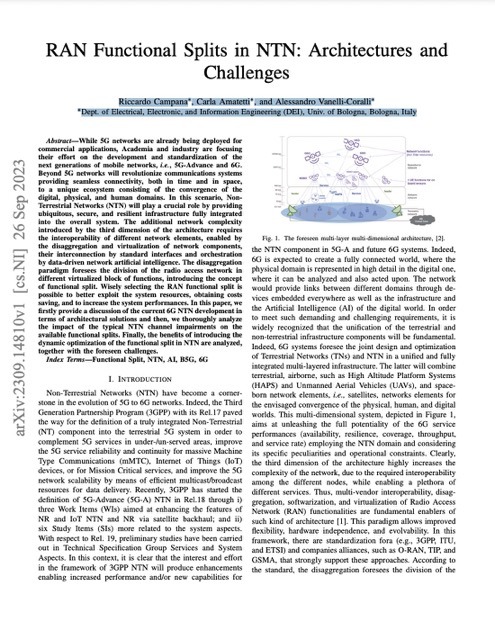
While 5G networks are already being deployed for commercial applications, Academia and industry are focusing their effort on the development and standardization of the next generations of mobile networks, i.e., 5G-Advance and 6G. Beyond 5G networks will revolutionize communications systems providing seamless connectivity, both in time and in space, to a unique ecosystem consisting of the convergence of the digital, physical, and human domains. In this scenario, NonTerrestrial Networks (NTN) will play a crucial role by providing ubiquitous, secure, and resilient infrastructure fully integrated into the overall system. The additional network complexity introduced by the third dimension of the architecture requires the interoperability of different network elements, enabled by the disaggregation and virtualization of network components, their interconnection by standard interfaces and orchestration by data-driven network artificial intelligence. The disaggregation paradigm foresees the division of the radio access network in different virtualized block of functions, introducing the concept of functional split. Wisely selecting the RAN functional split is possible to better exploit the system resources, obtaining costs saving, and to increase the system performances. In this paper, we firstly provide a discussion of the current 6G NTN development in terms of architectural solutions and then, we thoroughly analyze the impact of the typical NTN channel impairments on the available functional splits. Finally, the benefits of introducing the dynamic optimization of the functional split in NTN are analyzed, together with the foreseen challenges.

DOI: 10.48550/arXiv.2309.14810

Scientific publication

Improved Graph-Based User Scheduling for Sum-Rate Maximisation in LEO-NTN Systems

Bilal Ahmad, Daniel Gaetano Riviello, Alessandro Guidotti, and Alessandro Vanelli-Coralli – 2023 IEEE International Conference on Acoustics, Speech, and Signal Processing Workshops (ICASSPW) – June 04-10 2023 – Rhodes island, Greece

In this paper, we study the problem of user scheduling for Low Earth Orbit (LEO) Multi-User (MU) Multiple-Input-Multiple-Output (MIMO) Non-Terrestrial Network (NTN) systems with the objective of maximizing the sum-rate capacity while minimizing the total number of clusters. We propose an iterative graph-based maximum clique scheduling approach with constant graph density. Users are grouped together based on the channel coefficient of correlation (CoC) as dissimilarity metric and served by the satellite via Space Division Multiple Access (SDMA) by means of Minimum Mean Square Error (MMSE) digital beamforming on a cluster basis. Clusters are then served in different time slots via Time Division Multiple Access (TDMA). The results, presented in terms of per-cluster sum-rate capacity and per-user throughput, show that the presented approach can significantly improve the system performance.

Scientific publication

O-RAN based Non-Terrestrial Networks: Trends and Challenges

Riccardo Campana, Carla Amatetti, and Alessandro Vanelli-Coralli – EuCNC & 6G Summit 2023 – June 6, 2023 – Gothenburg, Sweden

While 5G networks are already being deployed for commercial applications, Academia and industry are focusing their effort on the development and standardization of the next generations of mobile networks, i.e., 5G-Advance and 6G.

Beyond 5G networks will revolutionize communications systems providing seamless connectivity, both in time and in space, to a unique ecosystem consisting of the convergence of the digital, physical, and human domains. In this scenario, Non-Terrestrial Networks (NTN) will play a crucial role by providing ubiquitous, secure, and resilient infrastructure fully integrated into the overall system. The NTN nodes will be organized into a Multi- Layer Multi-dimensional (ML-MD) architecture. This ML-MD network will rely on the interoperability of very different network elements, enabled by the disaggregation and virtualization of network components, their interconnection by open standard interfaces and orchestrated by data-driven network Artificial Intelligence. This paradigm, which has been standardized by the O-RAN Alliance, is now being implemented in Terrestrial Networks (TNs) but has not been fully addressed in NTN, yet. Therefore, this paper aims at exploring the possible implementation of an NTN infrastructure based on the O-RAN approach. By starting with the review of the State of the Art of O-RAN in TNs and flying platforms, we identify a possible architecture solution for an O-RAN-based NTN system and we foresee the ORAN implementation trends that will increase the NTN system efficiency.