
6G-NTN Final Results
The 6G-NTN project was exploring how to seamlessly integrate non-terrestrial networks (NTNs), such as satellites and high-altitude platforms (HAPs), into the future 6G ecosystem. With the goal of enabling resilient, sustainable, and globally accessible 6G connectivity, the project was focused on defining key requirements, developing architectural solutions, and addressing regulatory and technological challenges.
The results presented below reflect the progress achieved during its 36-month course (January 2023 – December 2025).
Use cases and user requirements
6G-NTN defined seven use cases and identified corresponding user requirements, taking into consideration service performance and usage constraints. These requirements and constraints have been structured and presented for three representative User Equipment (UE) types:
Sustainability considerations
To ensure efficient system dimensioning, the project addressed reference traffic scenarios and developed sustainability metrics, including energy efficiency. These efforts also considered the broader environmental footprint and handprint of 6G-NTN-based systems, enabling the definition of initial sustainable design principles.
3D multi-layered network architecture
The full-fledged integration of the NTN component into 6G is based on the design of a sustainable and resilient 3D multi-layered network architecture. Therefore, the proposed architectural framework consists of a three-layer design:
• HAPs serving as flexible nodes for local capacity and coverage enhancement
• Two LEO constellations (400 km to 800 km altitude) supporting C-band and Q/V-band connectivity
• An overlay of three GEO satellites
For the LEO constellations, two architectural solutions are proposed:
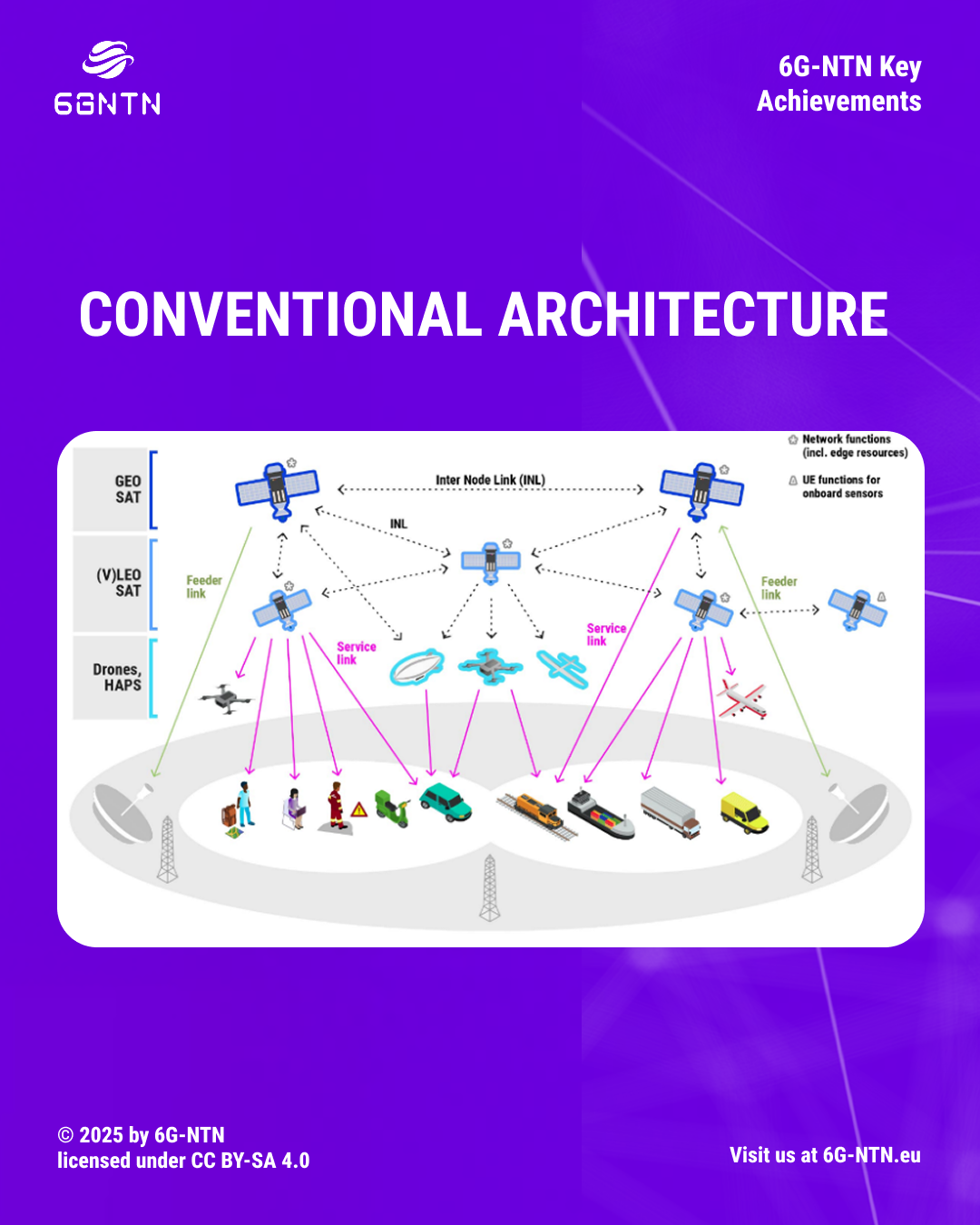
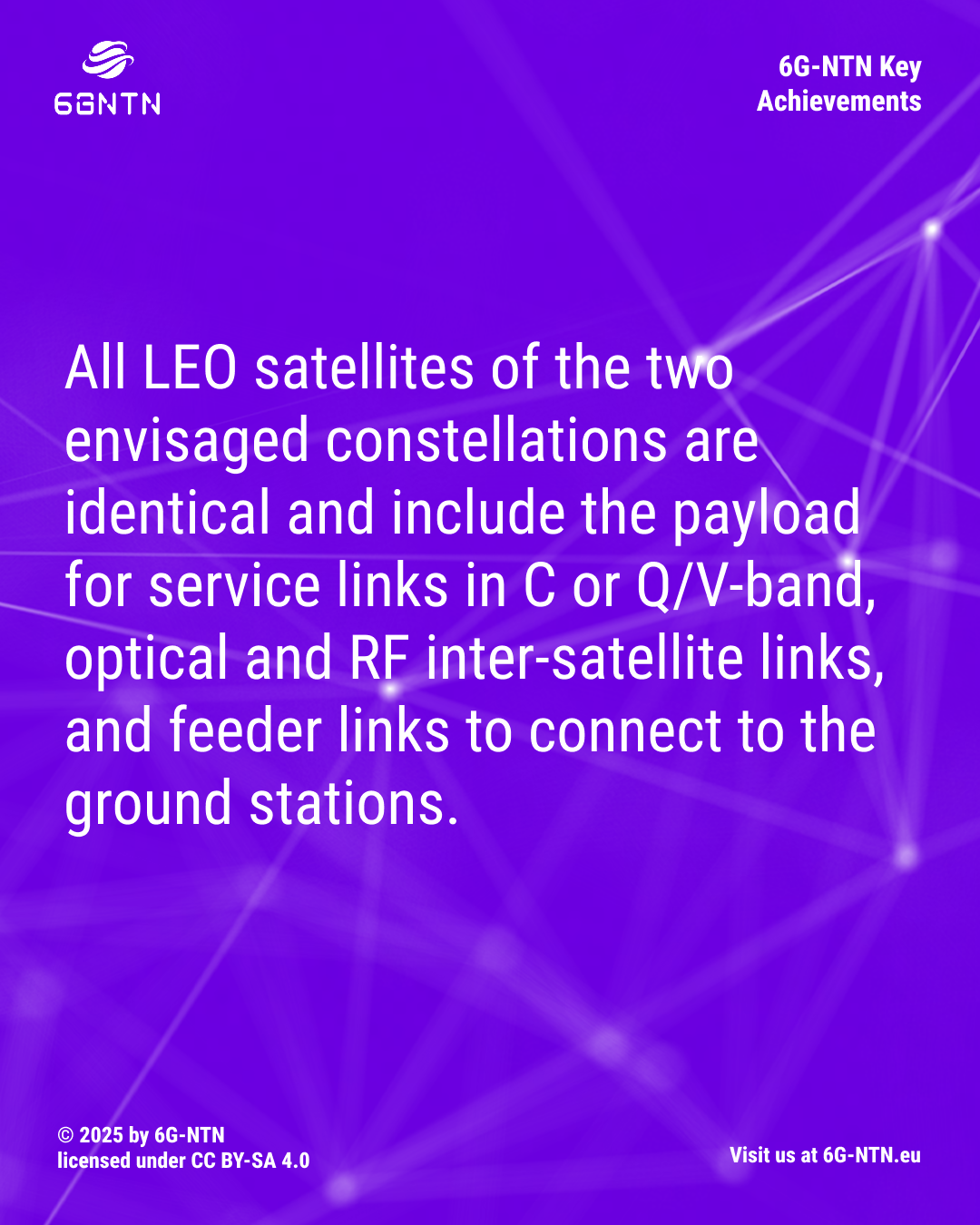
• A conventional architecture consisting of identical LEO satellites (in terms of functionalities and roles)
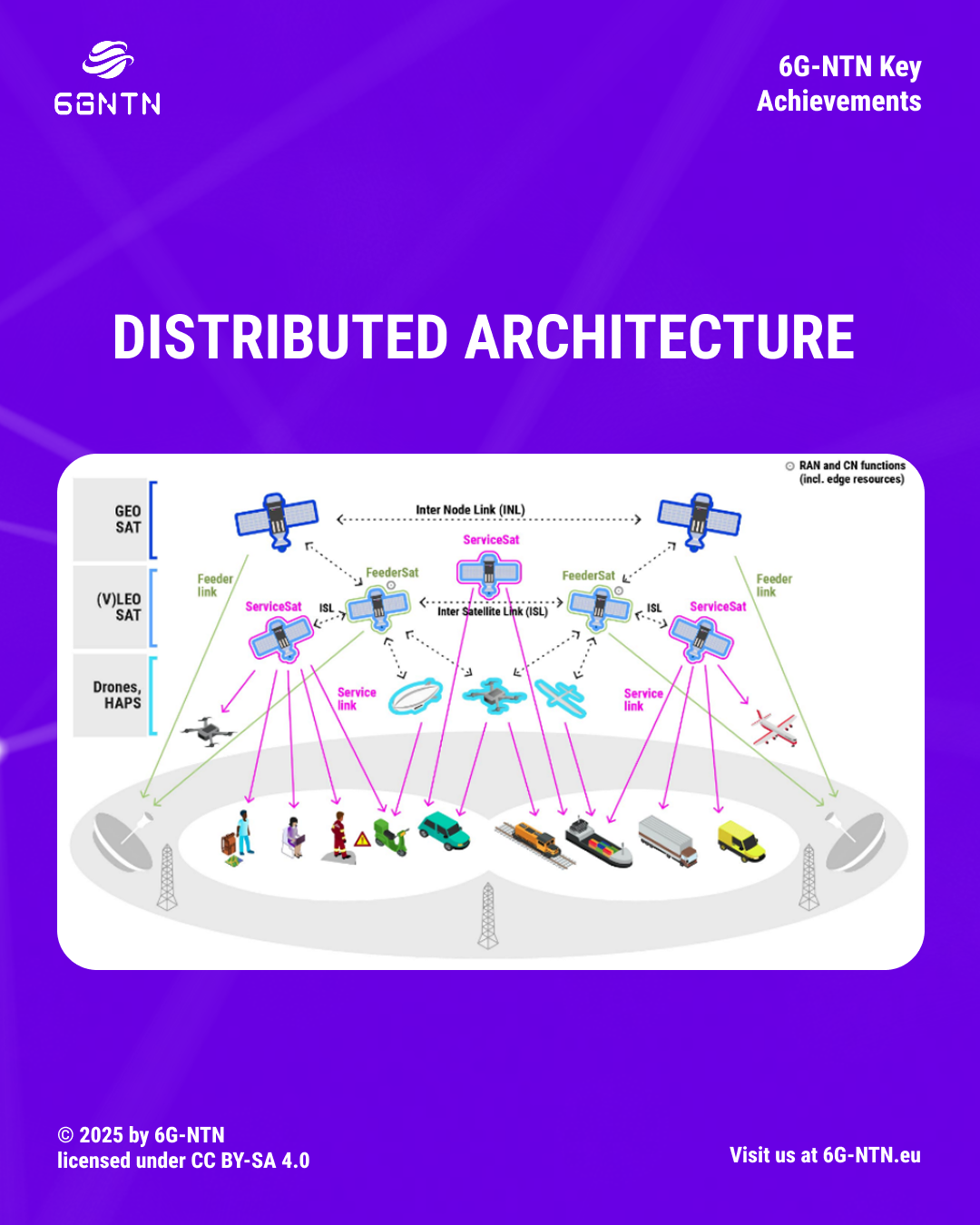
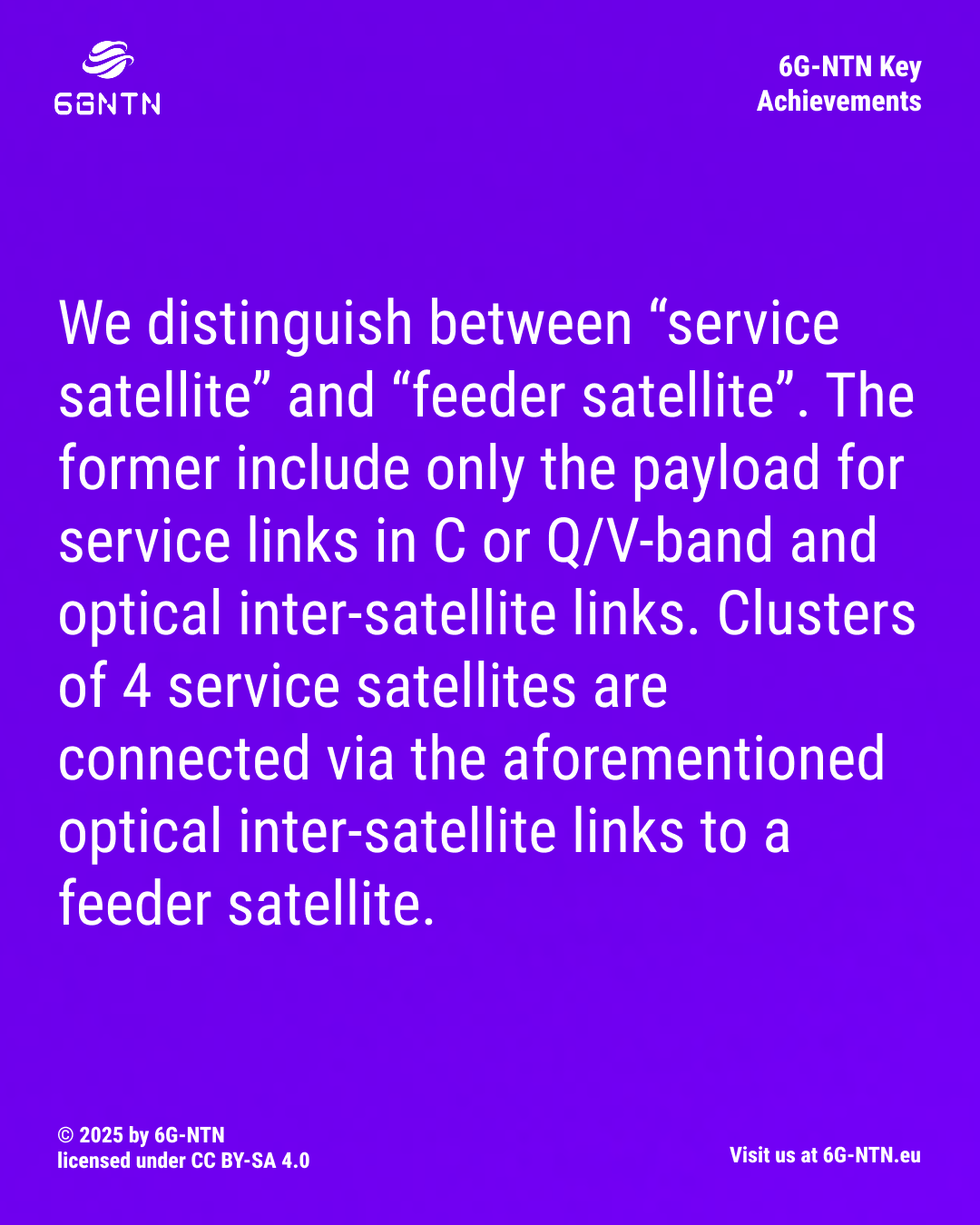
• A distributed architecture made up of heterogeneous satellites, i.e., “service satellites” and “feeder satellites”
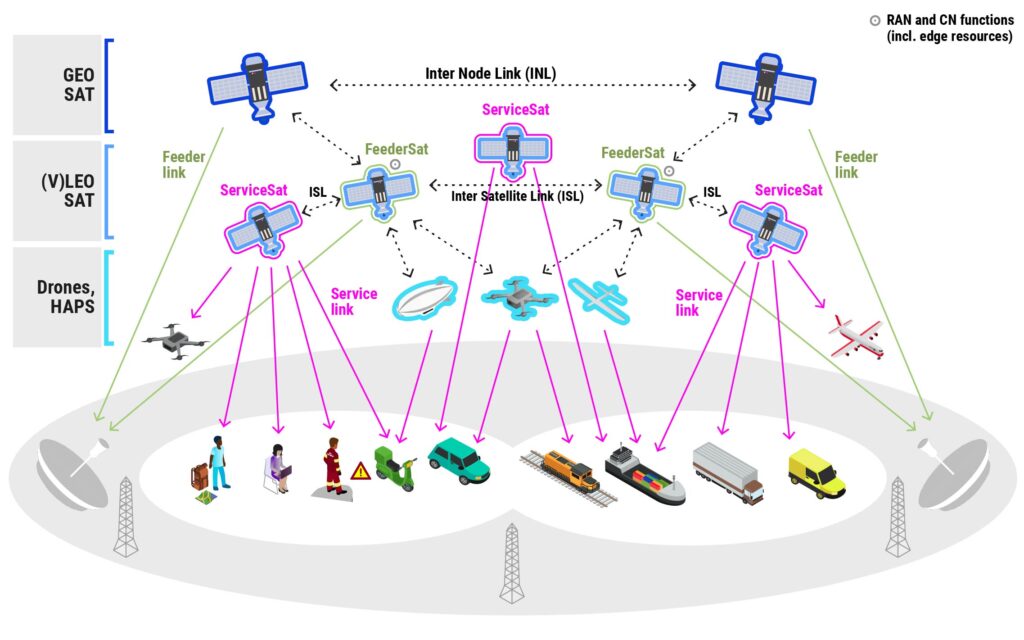
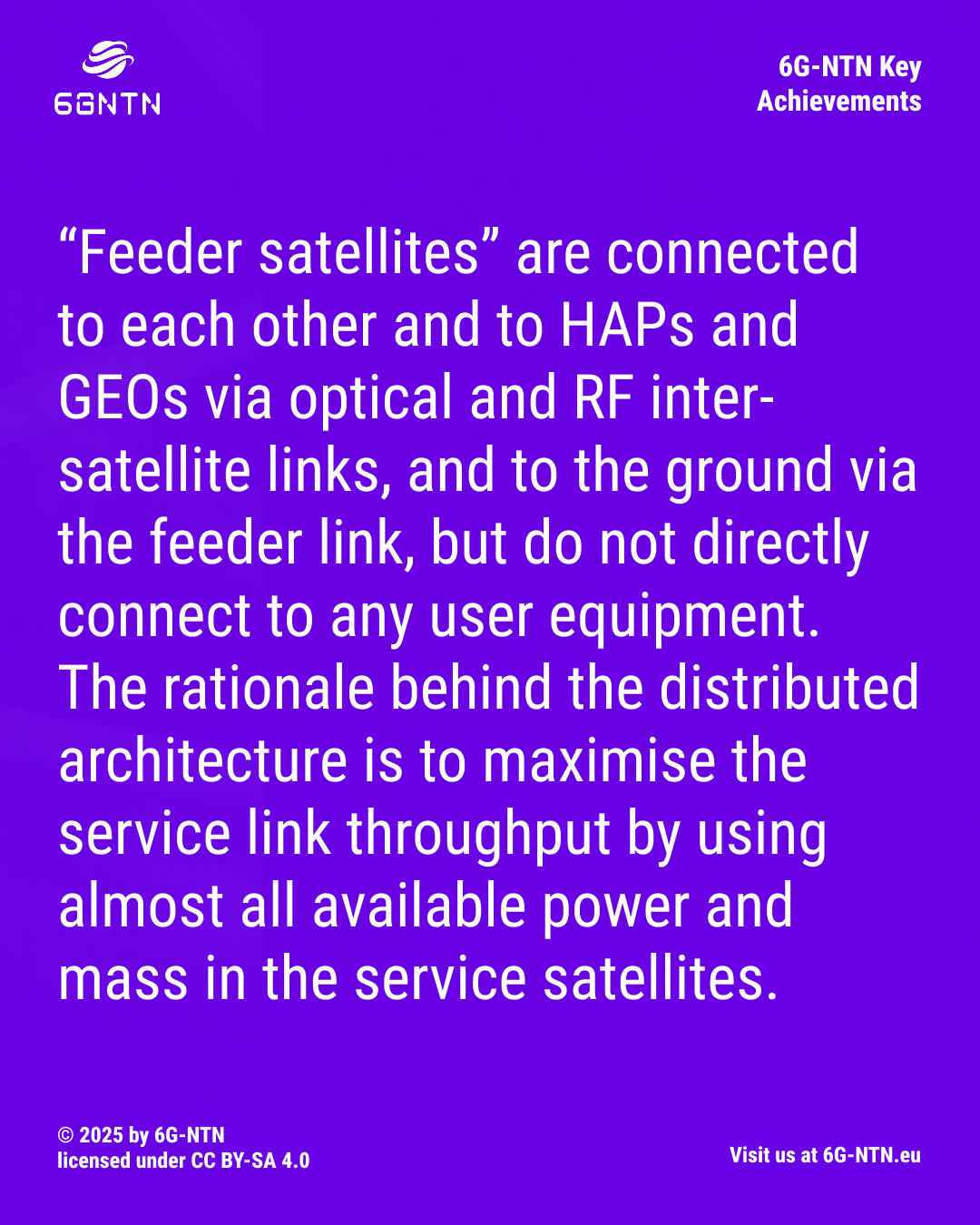
The rationale behind the distributed architecture is to maximize the service link throughput by using almost all available power and mass in the service satellites. Conversely, feeder satellites should have enough available power and mass to implement all necessary Radio Access Network (RAN) and, eventually, Core Network (CN) functionalities in space.
Key design parameters for the constellations considered include Doppler shift, delay, coverage overlap, and node distance variations. Architectural options were thoroughly evaluated based on link budgets for user, feeder, and internode links (RF/optical).
According to the designs of the two LEO constellations, different functional split options have been proposed, spanning from lower layer split in space, leveraging the distributed architecture, to adaptive functional split tailored to the use case requirements.
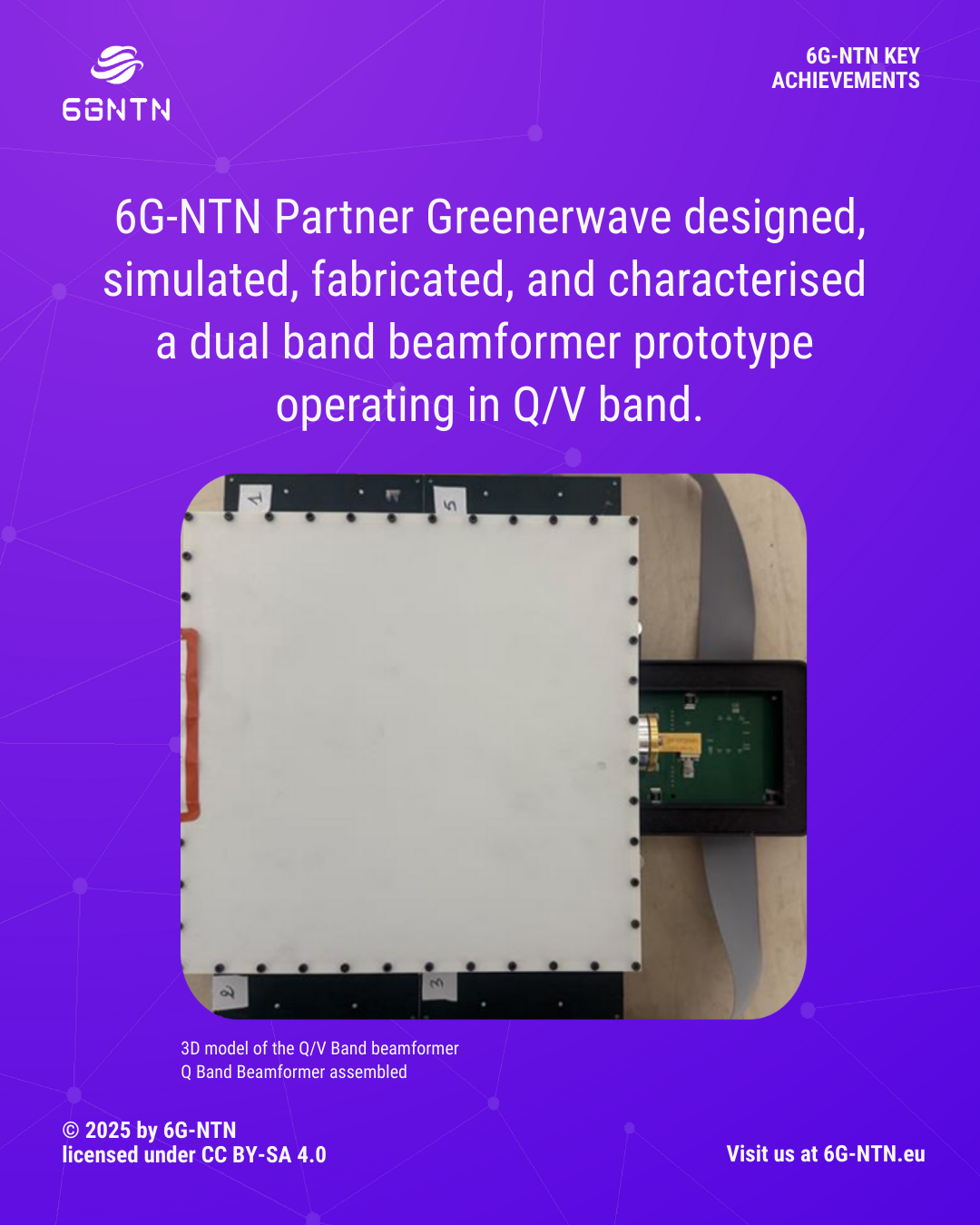
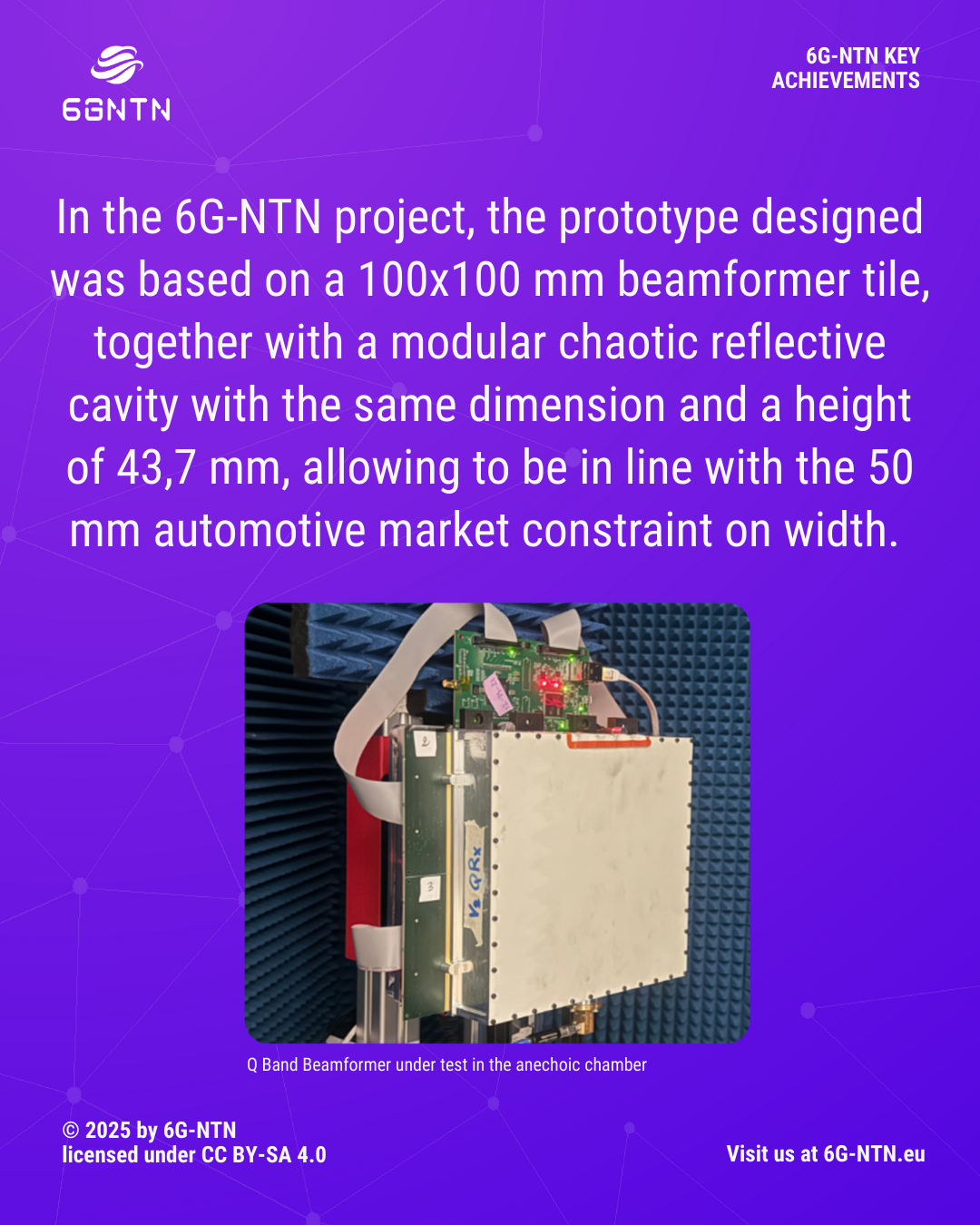
A critical aspect of the project has been payload design. Preliminary payload architectures were developed, considering the functions and missions while ensuring compliance with frequency regulations. For terminals, new Q/V-band antenna designs are being developed and characterized to meet size constraints.
The use of Q/V bands and C bands has raised regulatory considerations, such as the allocations of frequency ranges to services, the protection of terrestrial and satellite services, and the appropriate use of the frequency bands to which NTN has access. In particular, the project outcomes include insight into the regulatory environment that covers NTN and the current rules and regulations regarding the use of spectrum that can be used to conceptualize NTN operations and highlight the system needs that may require either the introduction of new rules or the modification of existing ones to facilitate the development of a harmonized NTN environment.
Moreover, the introduction of new potential bands for satellite communications (Q/V and C bands) for 6G led to the definition of preliminary coexistence scenarios and techniques to improve spectrum allocation using interference mitigation.
Both NTN-TN and NTN-NTN coexistence have been studied using very small antenna apertures, typically on the order of 10–20 cm. The results indicate favorable NTN-TN coexistence when employing antenna arrays. Additionally, studies on NTN-NTN coexistence demonstrate promising exclusion angle requirements for multi-orbit implementations.
To support the development of a natively integrated air interface for 6G NTN services, including LEO satellites and ultra-low-cost terminal apertures with TN convergence, a preliminary set of candidate waveforms has been identified and compared. These include Cyclic Prefix Orthogonal Frequency Division Multiplexing (CP-OFDM), Weighted Overlap and Add OFDM (WOLA-OFDM), discrete Fourier transform spread OFDM (DFT-s-OFDM), Filter – OFDM (F-OFDM), Block Filtered OFDM (BF-OFDM), Universal Filter Multi-Carrier (UFMC), and Orthogonal Time Frequency Space (OTFS).
Another major advancement lies in the design of an AI-enabled RAN intelligent controller (RIC) that hosts the AI/ML network resources optimization platform across terrestrial networks (TN) and non-terrestrial networks (NTN). In this context, the contribution is twofold:
- 6G-NTN AI/ML architecture aspects that support the deployment of various AI/ML-based resource optimization network functions: Since each resource network function operates under different objectives, time scales, data dependencies, making a one-size-fits-all AI/ML deployment platform impractical for model training, inference and management. Thereby, the adopted architecture leverages the flexibility of 3GPP and O-RAN compliant frameworks, incorporating hierarchical intelligence distribution and split learning paradigms across on-ground and in-space segments.
- Beyond AI/ML deployment aspects: This highlights the need for adaptive learning and continuous optimization of resources within each network function. The inherently non-stationary nature of NTN environment necessitates AI/ML models for continual adaptation to evolving network conditions. To this end, each network function employs advanced learning strategies encompassing single agent and multi-agent AI/ML techniques, with coordinated training and inference mechanism. This collaborative intelligence resulting in significant overall network efficiency gains and scalable resource management across the integrated ecosystem.
Interoperability between multi-orbit satellites and terrestrial networks is fundamental for reliability, resiliency, and global coverage in 6G. To achieve this, the project is developing a dynamic Virtual Network Function (VNF) orchestrator powered by AI. This includes the development of an AI-powered network forecasting platform to predict the utilization and demand for virtualized network resources.
Finally, 6G-NTN has initiated a development and deployment plan for 6G NTN-based satellite networks, assuming that the 5G NTN space segment could be refurbished to roll out some initial 6G NTN satellite networks.
6G-NTN results listed among SNS Key Achievements of 2025
The 1st highlighted 6G-NTN Key Achievement
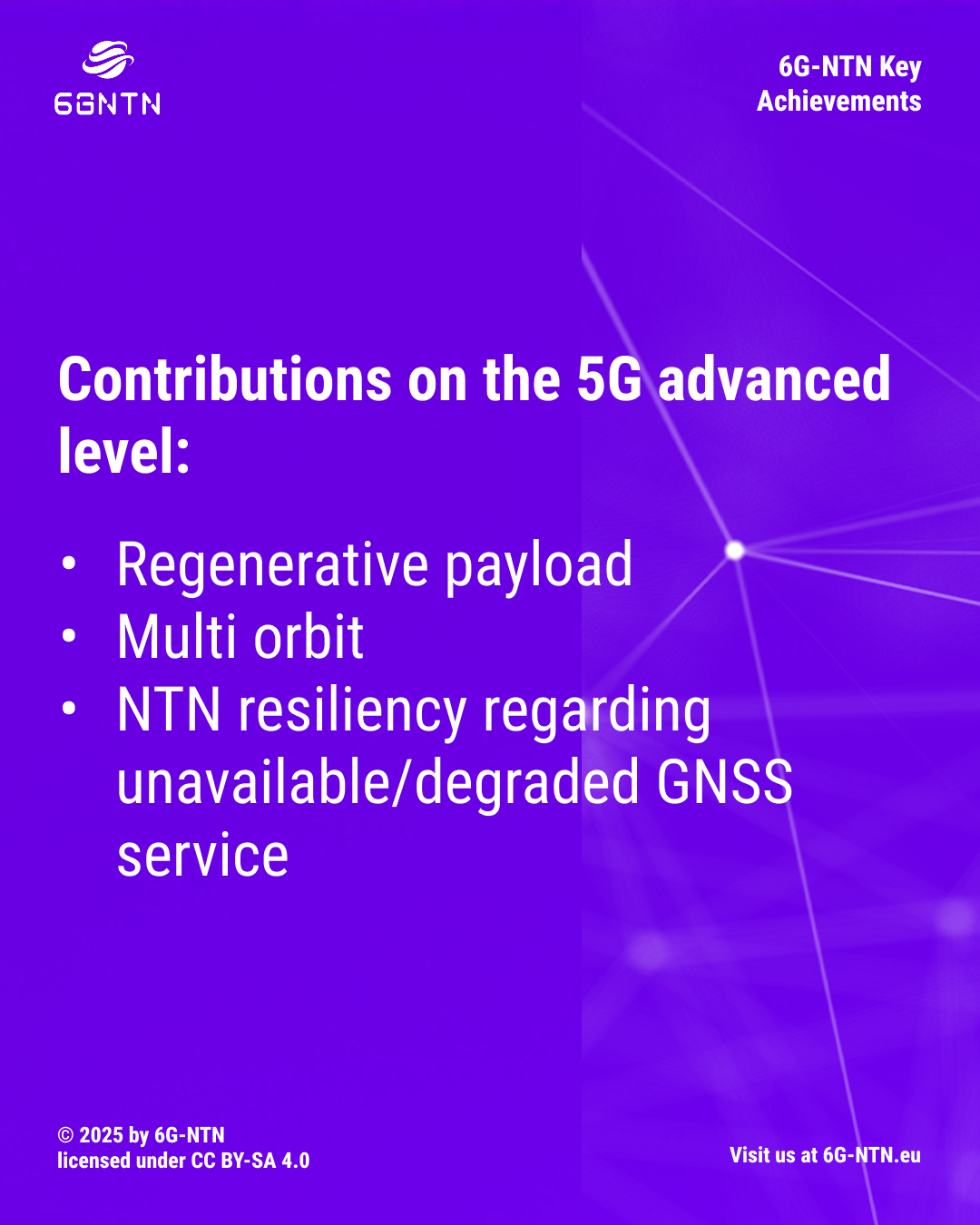
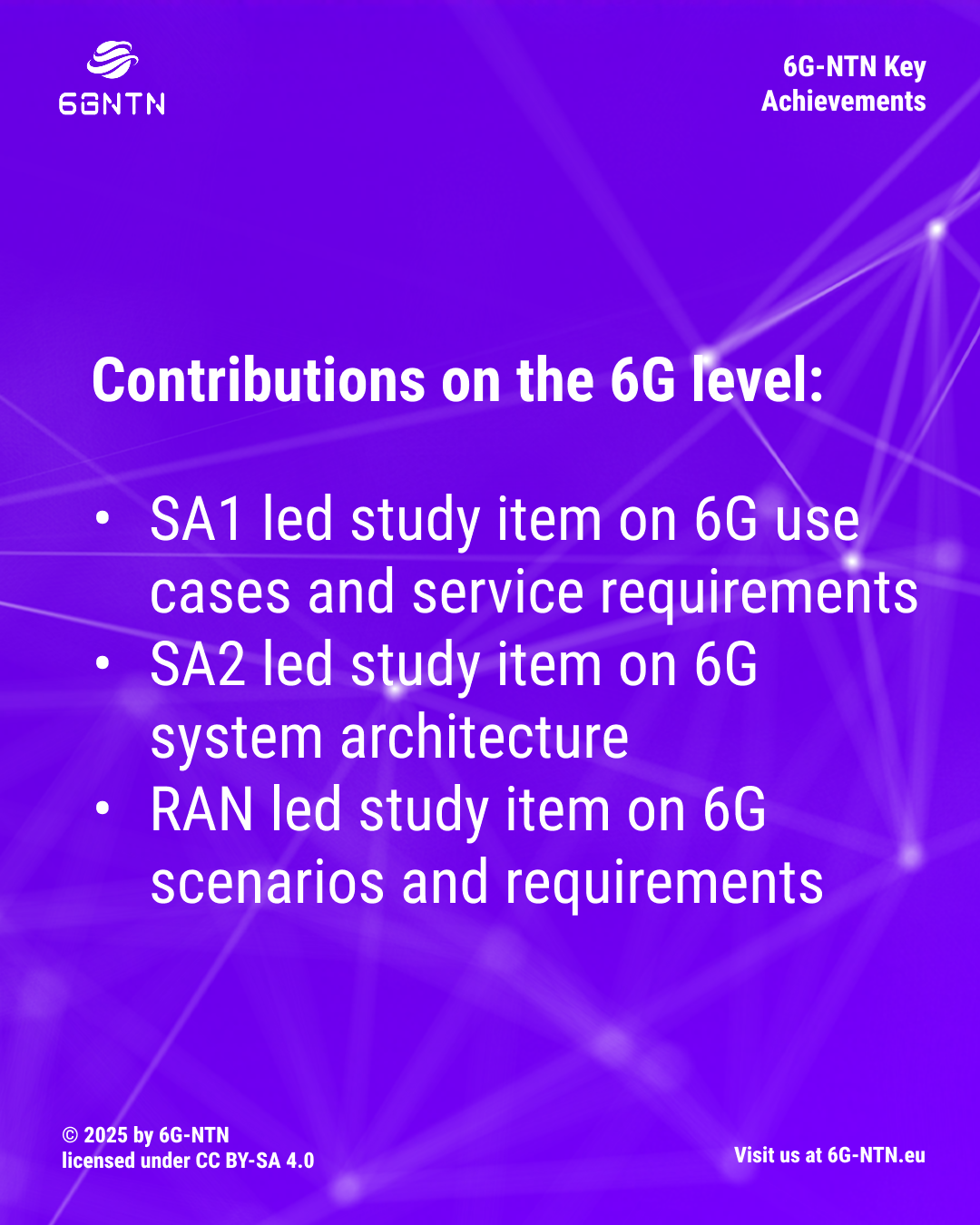
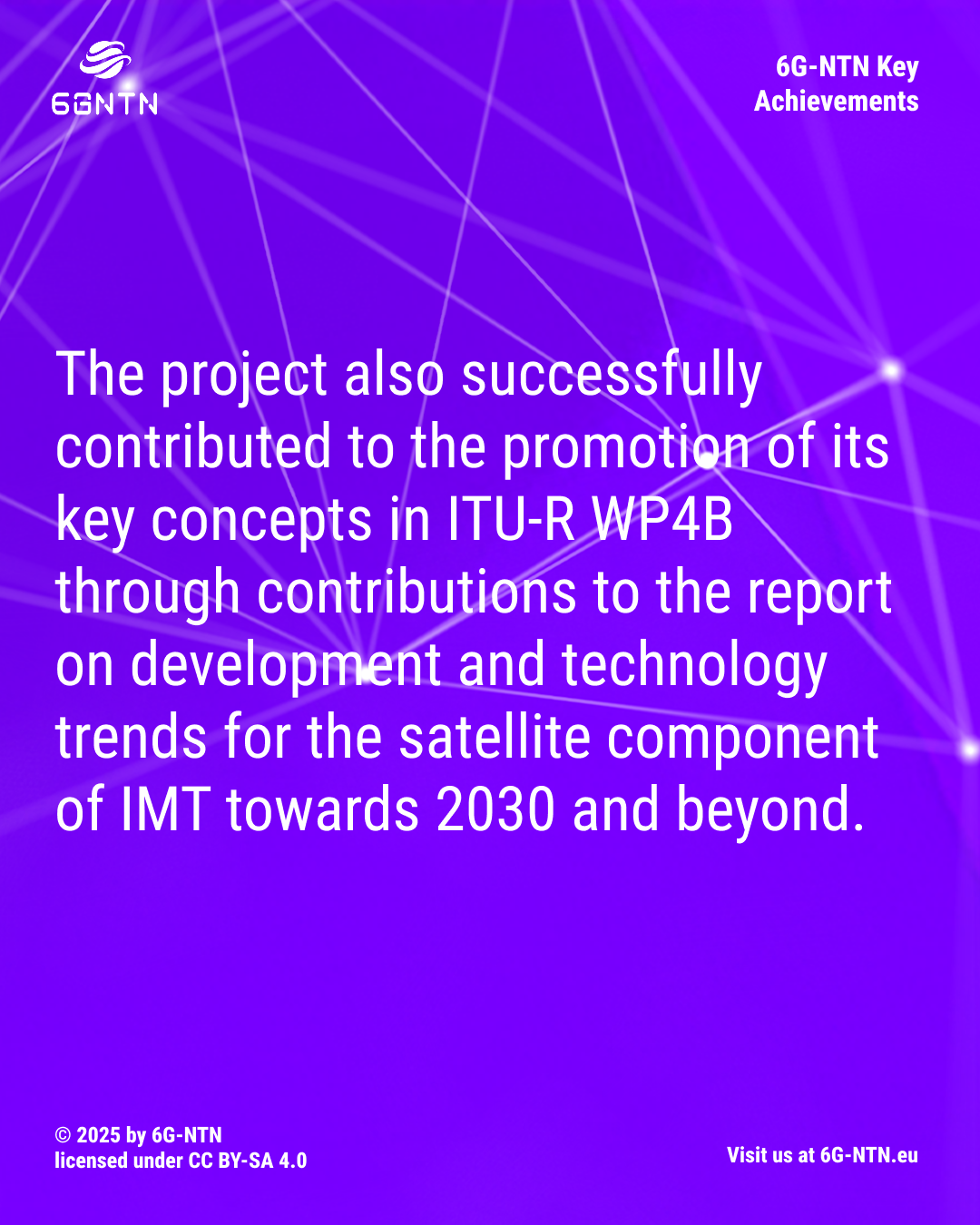
Significant contributions to 3GPP on the integration of NTN into 6G
The 2nd highlighted 6G-NTN Key Achievement
6G LEO based satellite network preliminary sizing for C band (direct to smartphones) and Q/V band (direct to vehicles)
The 3rd highlighted 6G-NTN Key Achievement
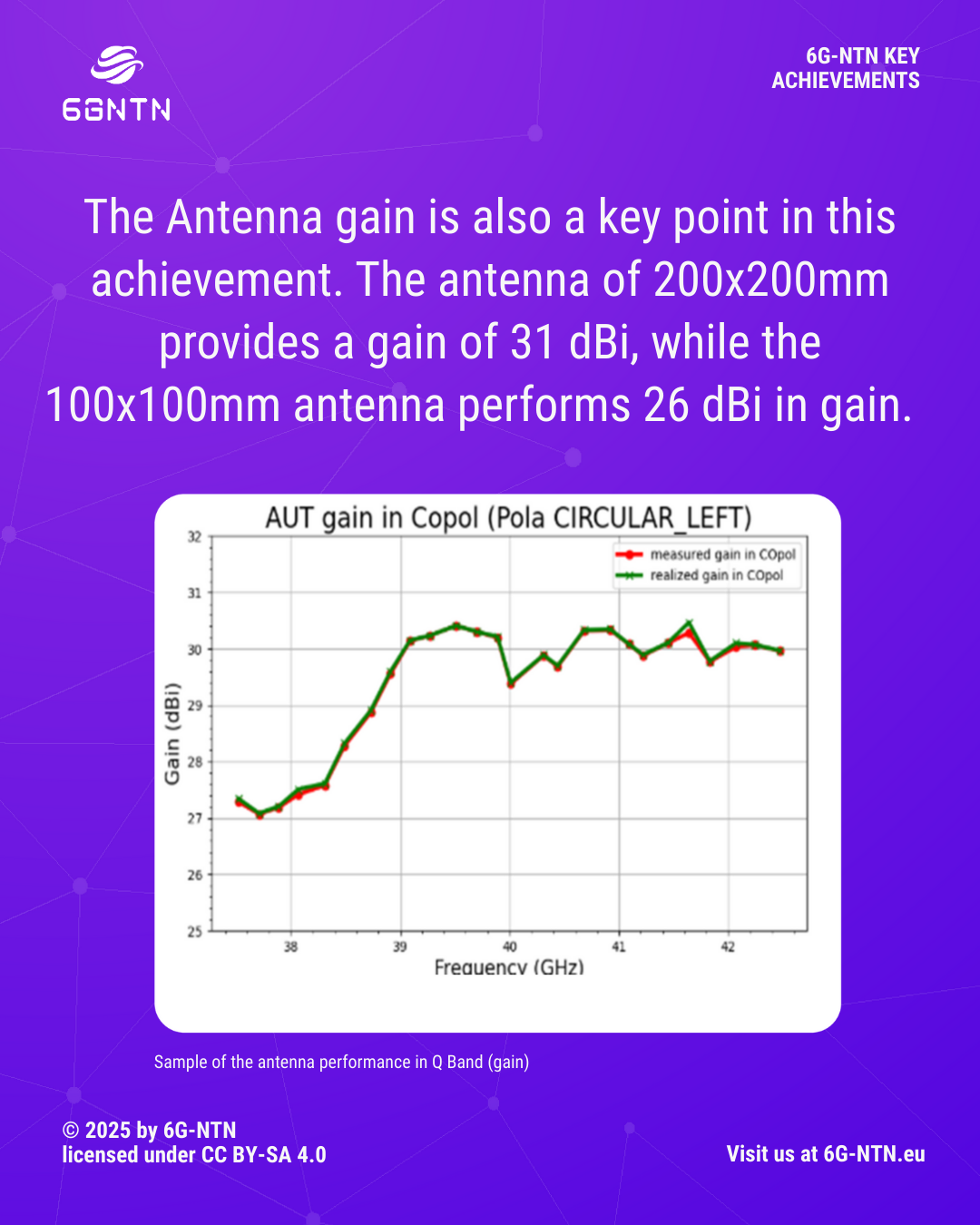
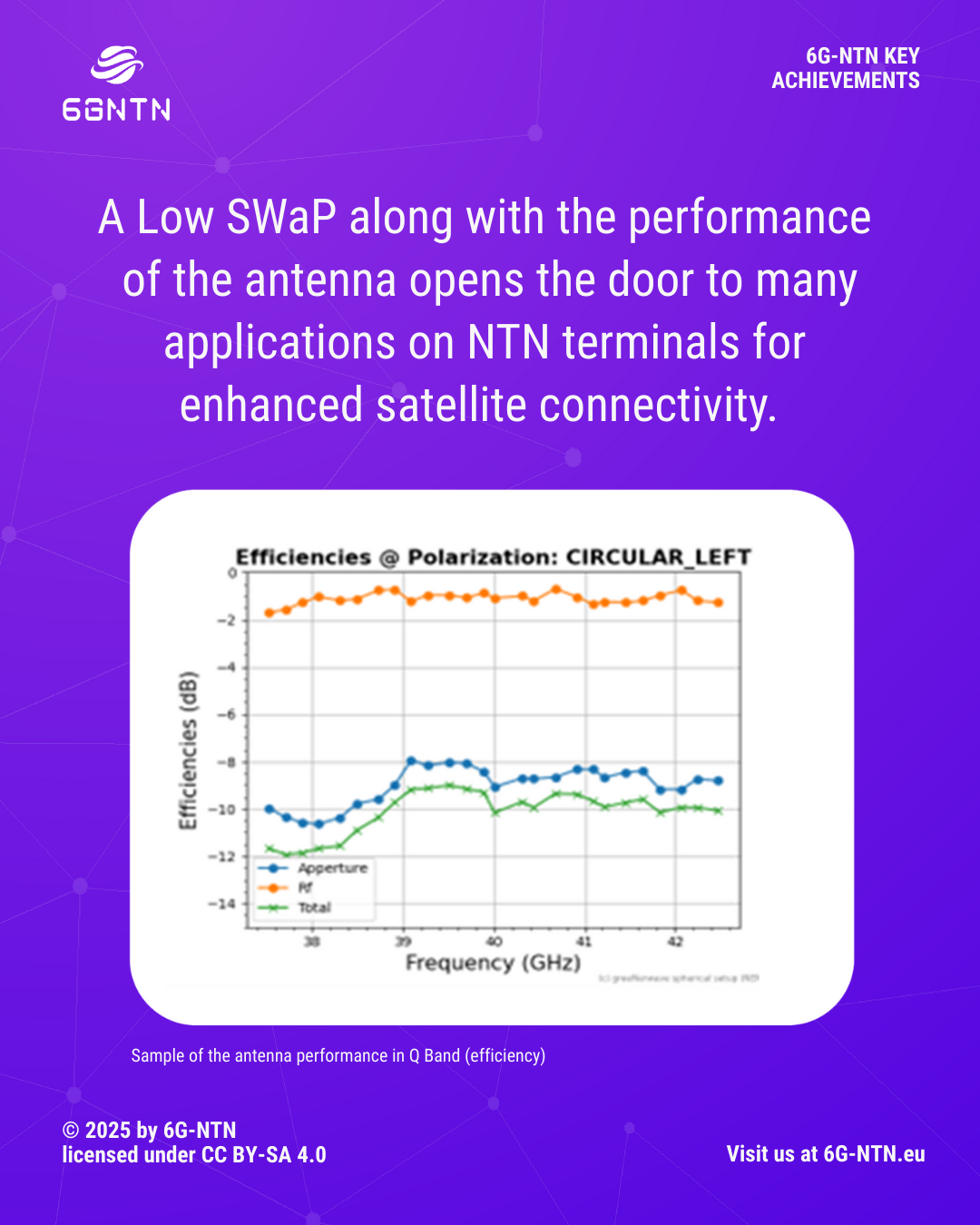
Q/V band antenna prototype for vehicles mounted devices