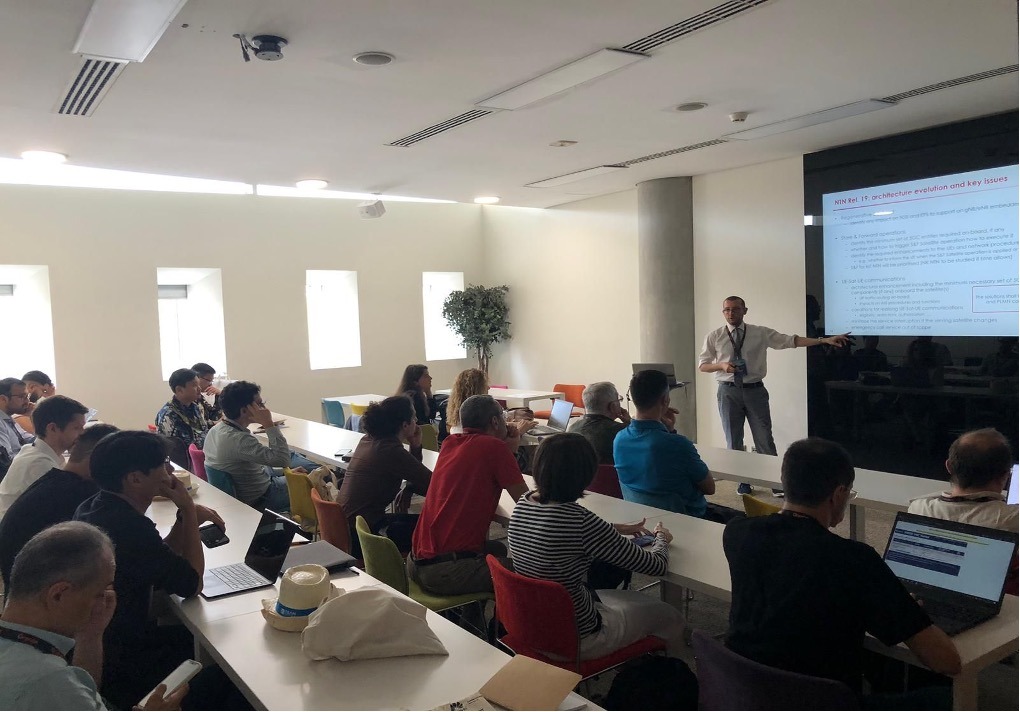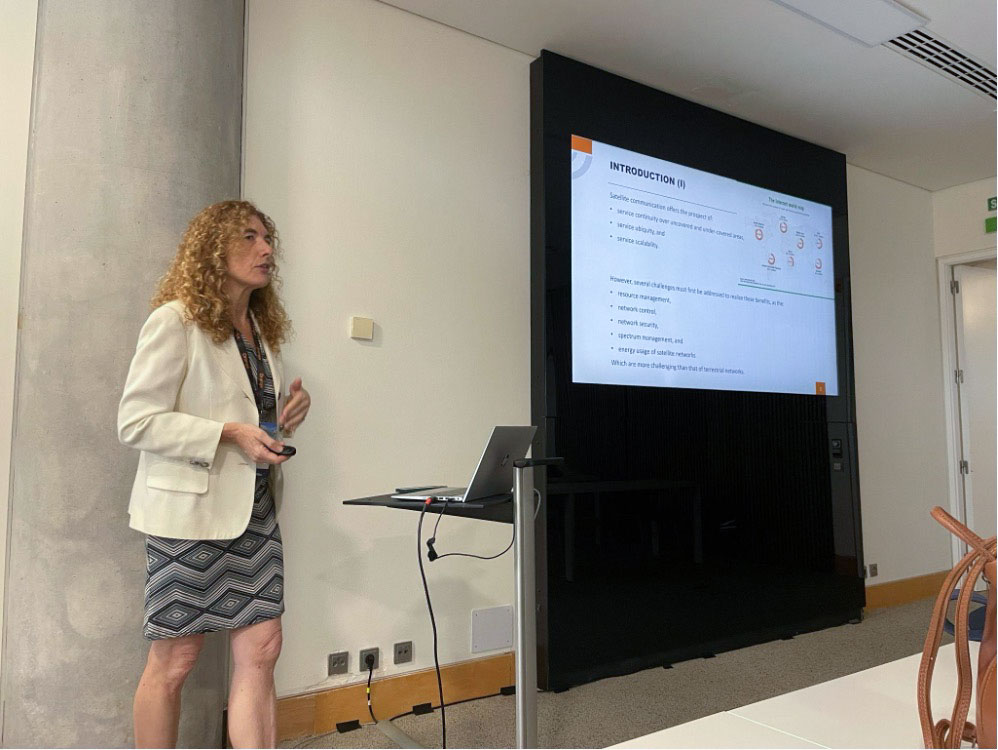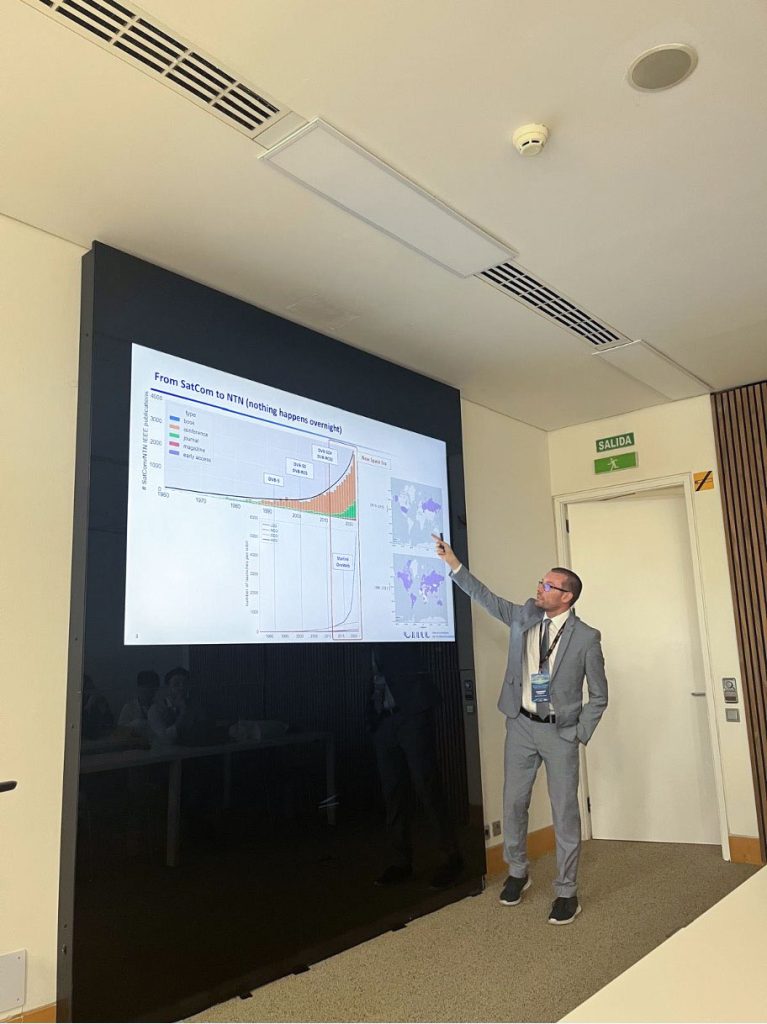

On Monday, September 2, 2024, at the IEEE PIMRC 2024, UNIBO, the 6G-NTN Coordinator, held a full-day workshop titled “6G-NTN: Architectures and Technologies,” focused on exchanging innovative ideas and insights and shaping new research directions on enabling techniques for integration and flexible network operation of NTN in 6G, targeting both infrastructural and technological aspects.
Innovative ideas explored at the workshop
Non-Terrestrial Networks (NTNs) are becoming increasingly important for enabling new applications in the 6G network, offering coverage in areas underserved by traditional TNs. Unlike previous generations, where NTNs complemented TNs, 6G will fully integrate terrestrial and non-terrestrial communications, creating a unified, optimised infrastructure across air, space, and ground.
The 3D infrastructure presents new challenges due to NTNs’ unique characteristics, such as dynamic network topologies and power constraints, requiring novel solutions, including AI-based approaches. The workshop was organised to explore innovative ideas and research directions to address these challenges and enable seamless NTN integration in 6G.
The full day event kicked off with a keynote delivered by Ana Perez-Neira of the Technical University of Catalonia and CTTC, followed by a keynote by Alessandro Guidotti of UNIBO. After that, a technical session took place, featuring the following presentations:
Priority-Focused Trajectory Planning for UAV-Assisted Full-Duplex OWC Systems
Jiawei Hu (Tsinghua University, China); Zongyao Zhao (Tsinghua University & Peng Cheng Laboratory, China); Xinke Tang (Peng Cheng Laboratory, China); Yuhan Dong (Tsinghua University, China)
Realistic Optimization Framework for UAV-BS Deployment in Integrated Aerial-Terrestrial Networks
Balaji Kirubakaran, Elham Younesian and Jiri Hosek (Brno University of Technology, Czech Republic)
Energy-Efficient UAV-Relayed High-Altitude Platform to Ground User Communication
Yijia Zhang (UNSW Sydney, Australia); Deepak Mishra (University of New South Wales (UNSW) Sydney, Australia)
Low-Complexity Joint Power and Spectrum Management for Non-Terrestrial Networks
Thang X. Vu, Cuong Le, Ashok Bandi and Symeon Chatzinotas (University of Luxembourg, Luxembourg)
An SDN-Based Solution for Mega-Constellation Routing
Marius Corici and Hauke Buhr (Fraunhofer FOKUS, Germany); Hemant Zope (Fraunhofer Fokus,Germany); Manar Zaboub (Fraunhofer FOKUS, Germany)
In the afternoon, a tutorial on 6G NTN was held by UNIBO’s Carla Amatetti and Alessandro Guidotti, after which a second technical session took place, featuring the following presentation:
iPhone Satellite Waveform: An Experimental Performance Evaluation
Jiawei Hu (Tsinghua University, China); Zongyao Zhao (Tsinghua University & Peng Cheng Laboratory, China); Xinke Tang (Peng Cheng Laboratory, China); Yuhan Dong (Tsinghua University, China)
IoT-NTN Communications via Store-And-Forward Core Network in Multi-LEO-Satellite Deployments
Victor Monzon Baeza (University Oberta Catalunya – Sateliot, Spain); Giovanni Rigazzi (SATELIOT,Spain); Sergio Aguilar (Sateliot, Spain); Ramon Ferrús (Universitat Politècnica de Catalunya, Spain); Josep Ferrer (Sateliot, Spain); Suvidha Mhatre (Universitat Politecnica de Catalunya, Spain); Marco Guadalupi (Guadalupi, Spain)
Satellite Adaptive Onboard Beamforming Using Neuromorphic Processors
Wallace A. Martins (ISAE-SUPAERO, France); Eva Lagunas (University of Luxembourg, Luxembourg); Nicolas Skatchkovsky (Francis Crick Institute, Luxembourg); Flor Ortiz and Geoffrey Eappen (University of Luxembourg, Luxembourg); Osvaldo Simeone and Bipin Rajendran (King’s CollegeLondon, United Kingdom, Great Britain); Symeon Chatzinotas (University of Luxembourg, Luxembourg)
End-To-End Delivery in LEO Mega-Constellations and the Reordering Problem
Rasmus Sibbern Frederiksen, Thomas Gundgaard Mulvad, Israel Leyva-Mayorga and Tatiana Madsen (Aalborg University, Denmark); Federico Chiariotti (University of Padova, Italy)
Green UAV-Enabled Internet-Of-Things Network With AI-Assisted NOMA for Disaster Management
Muhammad Ali Jamshed (University of Glasgow, United Kingdom, Great Britain); Ferheen Ayaz and Aryan Kaushik (University of Sussex, United Kingdom, Great Britain); Carlo Fischione (KTH, Sweden); Masood Ur-Rehman (University of Glasgow, United Kingdom, Great Britain)
The event gathered an audience of 30 attendees, who actively participated in discussions throughout the day. The key takeaway from the workshop, as summarised by Alessandro Guidotti is that a native inclusion of the NTN component in 6G will contribute to the resilience, flexibility, and sustainability of the system enabling service improvement and market enlargement. However, to achieve a fully harmonised 3D TN-NTN system, both evolutionary and revolutionary technologies will need to be researched and developed.
About IEEE PIMRC
The Annual IEEE International Symposium on Personal, Indoor and Mobile Radio Communications (PIMRC) has become one of the two major conferences of the IEEE Communications Society (ComSoc) in the field of wireless communications and networking. Originally founded in 1989 in London as a workshop and developed over the years to become a major international conference attracting the technical community from all regions and continents.